Telegram bot for checking websites ·
A website check in a minute, in words, not scores
Send the bot a link, and half a minute later a report arrives: how the website opens on a phone, whether Google can see it, whether it’s secure, and how a customer can start a conversation. Every point is written in plain words, and at the end you see what to fix first.

The task
A small business owner rarely knows what’s really going on with their website: whether it opens quickly on a phone, whether people will find it on Google, whether a link sent in a messenger shows up with a picture, and whether a customer can call with one tap. Free checks exist, but they answer with scores and technical terms, and it’s not clear what to do with them.
What was needed was a check you don’t have to learn: send a link to the place where you already chat, and get an answer in ordinary words. And at the end, it should be clear what to fix first.
What it delivered
A website is checked in half a minute, with no sign-up and no jargon: the report says what works, what’s worth fixing, and why it matters to a visitor. If you want it fixed, one button opens a chat with the developer, and the message already says which website was checked.
What I did
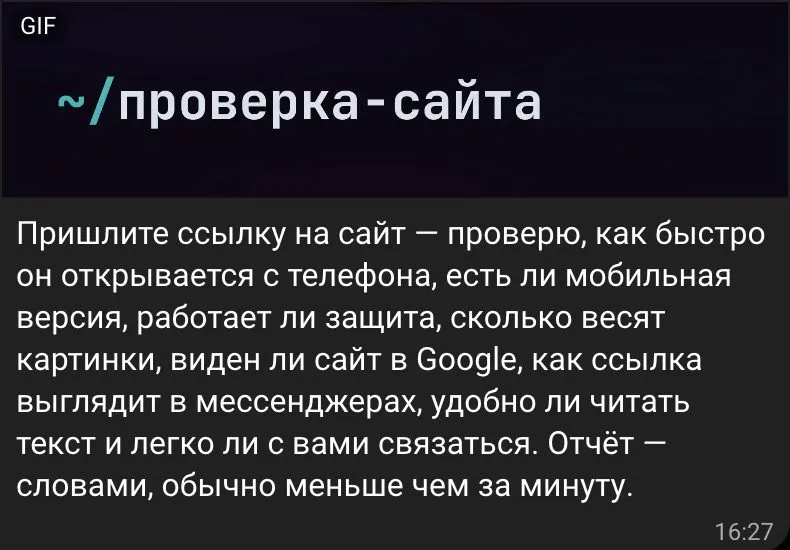
A link in any form
The address can be sent any way you like: with or without https://, with
www, a link to any page, a domain in Cyrillic. The bot replies “Checking…” right
away, and 15–60 seconds later that same message turns into the report. It
doesn’t send five messages in a row.
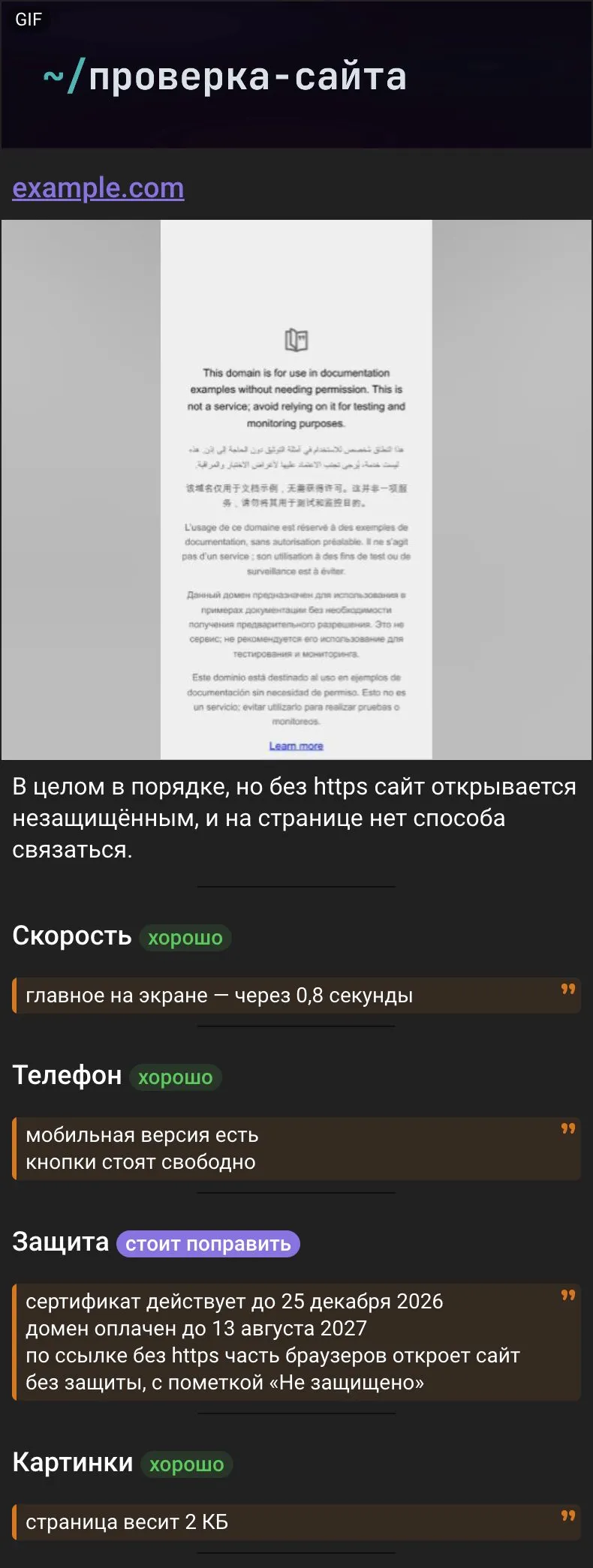
Eight checks in one report
Speed on a phone, mobile version, security, images, requests and contact details, Google search, the link in messengers, and readability. Each point gets a rating in words (“good,” “worth fixing,” “poor”) and a sentence or two on what it means for a visitor. At the top: a screenshot of the first screen on a phone and a one-line summary.
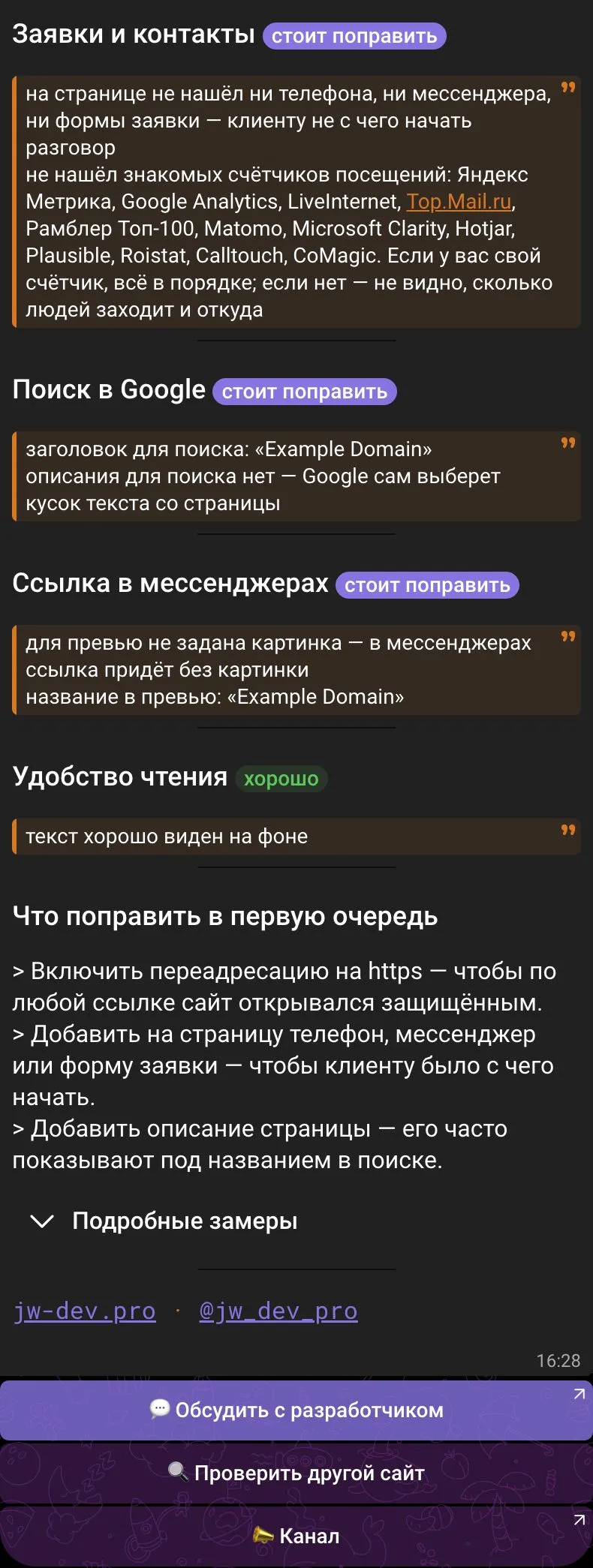
What to fix first
At the end come one to three points under “what to fix first,” each with an explanation of why. Under the report are three buttons: discuss with the developer, check another website, and the channel.
Findings the owner can see
The bot notices things the owner can check themselves: a phone number on the call button without the area code, so it can’t be dialed from a mobile phone; a page with no phone number, no messenger, and no contact form; no analytics, so you can’t see how many people visit; images that look blurry on a phone; a domain whose paid period is about to run out.
A repeat check shows the difference
If a person has already checked this address, the report shows what has noticeably changed since last time. If nothing has changed, the bot says nothing rather than repeating the same thing.
Nothing made up
The bot doesn’t judge the design or the text, and it doesn’t give numbers the owner can’t check for themselves, like “you’re losing half your customers.” There’s no AI in it: Google measures the page, and rules in the code check the rest.
Details for those who need them
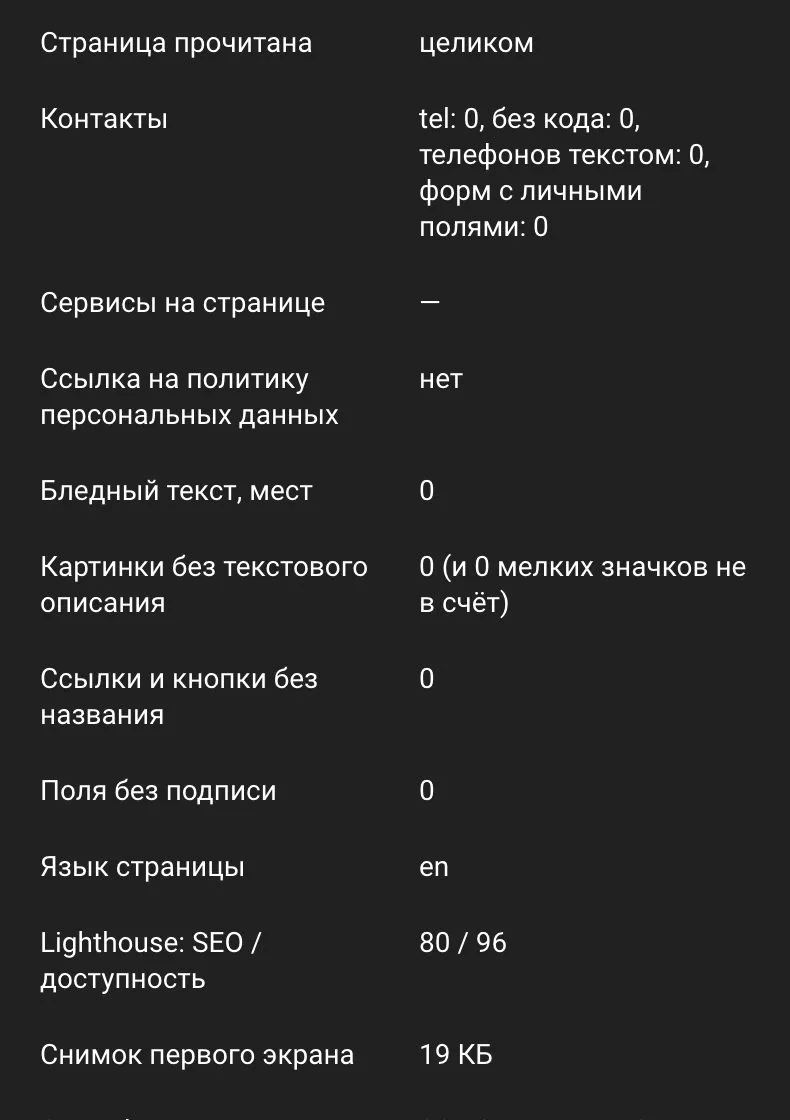
Below the report is a collapsed “Detailed measurements” block: exact numbers, the certificate, redirects, the domain’s paid period. It doesn’t get in the owner’s way, and a developer the owner forwards the report to can see right away what each point is based on.
Other people’s links are safe for the server
The bot runs on a home server and opens other people’s addresses. So it stays out of the internal network: addresses are checked before connecting, and the bot’s container has its own network protection. The limit is 10 checks a day per person, so the bot can’t be flooded with links.
Need a bot that does the first piece of work for a customer on its own and brings them to you?
Message meWhat this gives the business going forward
Why a business would want a bot like this
A person sends their own task and gets something useful right away. Anyone who wants it fixed messages you, and the message already shows which website it’s about.
Can something similar be made for my niche
Yes: a bot that makes a first estimate or review from a photo, a link, or a couple of answers, and then hands the customer over to you.
How much does a check cost
Nothing: the bot is free, 10 checks a day per person. Check your own website at @jw_site_check_bot.
How it works technically
Python 3.12, aiogram 3 (Bot API 10.3), SQLite, Docker. Speed, the mobile version, and search are measured by PageSpeed Insights (Lighthouse on Google’s servers); the certificate, redirects, the domain’s paid period (RDAP and whois), contact details, the link preview, and analytics are my own checks in code. Home network protection: the address is checked before connecting, plus separate nftables rules for the container. A queue of two checks at a time, limits of 10 a day per person and 500 for all users combined. Russian and English, depending on the Telegram language setting. 1,105 tests. The code is open: github.com/jw-git-hub/jw_site_check_bot.
Who did the work
It’s just me behind jw-dev.pro, not a studio or an agency. That means you talk directly to the person doing the work: no manager, no brief relayed through third parties, and no passing the project to another contractor partway through.
My time zone is UTC+7, the same as Bangkok and Hanoi. I build websites, Telegram bots, and automation: a task rarely ends with a page, and it usually has to be connected to what you already have running.
As time goes on, the task sounds like “build a website” less and less often. One person needs a price to be changed in one place, not on twenty pages. Another needs the channel to run without them. A third needs the whole price list to sit inside Telegram, where their customers already go every day. That’s why the list of what I do is open-ended: if your task isn’t on it, that doesn’t necessarily mean it can’t be solved.
I write case studies so that they can be checked: what was there, what was done, and how it was measured. If there is analytics data, I give the numbers and the period they cover; if it is too early to measure, I say so. You won’t find “increased sales” here: that is a promise, not a result.
Need something similar?
Whether it’s a website, a bot, or something that is now done by hand, tell me what’s going on, and I’ll tell you whether it can be solved or not.
This kind of work is the service “Custom Telegram bot development for business.”
Your request was not sent
Your text is not lost: go back and try again. Or contact me directly: on Telegram, on WhatsApp, or by email.
If it’s easier, contact me directly: on Telegram, on WhatsApp, or by email.
Not sure what’s wrong with your website? Check it for free on Telegram: @jw_site_check_bot.
Who owns everything afterward and what happens if I disappear: answers on the home page.